Expectations
This page explains how Expectations work in OpenAEV: what they are, why they matter, how to configure them, and how they impact the outcome of a simulation.
Expectations define what success means when an Inject targets an Asset (endpoint) or a Player during an Inject execution.
What are Expectations?
What is this?
An Expectation defines a measurable outcome for an Inject. It answers the question:
What should happen for this Inject to be considered successful?
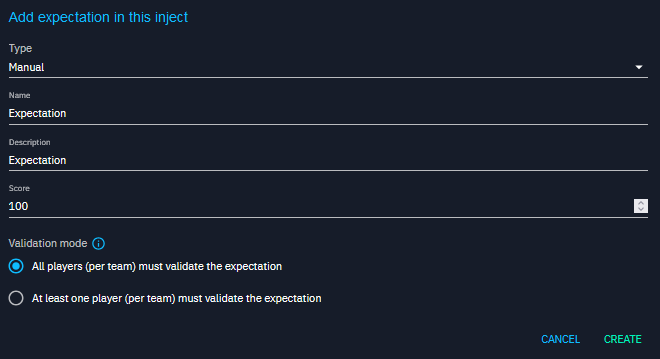
Each expectation:
- is attached to an Inject
- has a score
- has a validation mode
- is validated either manually or automatically
- contributes to the simulation result
Why use Expectations?
Expectations allow you to:
- Objectively measure security posture
- Evaluate both technical controls and human behavior
- Standardize scoring across exercises
- Decide when a simulation is complete
Expectation Types (Overview)
Expectations fall into two categories, depending on how validation occurs.
Manual Expectations (Human validation)
Manual expectations are validated by an organizer. They are used to evaluate human actions such as decision-making or escalation.
⚠️ These expectations can only be used in the context of human-based injects, such as email or SMS, where a real person is expected to read, interpret, and react to inject.
Typical use cases:
- tabletop exercises
- incident response drills
- awareness and training scenarios
Automatic Expectations (Technical validation)
Automatic expectations are validated by technical signals.
They rely on:
- connected security tools
- or manually provided technical results
⚠️ These expectations can only be used in the context of technical injects, where system or security signals are produced automatically (for example: logs, alerts, detections, or telemetry).
They are essential for technical simulations and Breach & Attack Simulation use cases.
Validation Modes (Overview)
A Validation Mode defines how individual target results aggregate at group level.
Each expectation uses exactly one validation mode.
All targets must validate
- All targets succeed → 100
- At least one target fails → 0
Typical use cases:
- compliance checks
- mandatory training
- baseline security requirements
At least one target must validate
- ≥ 1 success → 100
- No success → 0
Typical use cases:
- SOC detection
- escalation workflows
- redundancy testing
When is a Simulation Finished?
A simulation is considered finished once all expectations are resolved:
- Technical expectations → detection, prevention, vulnerability
- Human expectations → manual validation
Until then, the simulation remains in progress.