Validation
Expectations — Validation, Aggregation & Propagation
This page explains how OpenAEV computes expectation results, from individual signals to organizational outcomes.
Manual Expectations (Detailed)
A Manual Expectation requires validation by the organizer.
OpenAEV does not infer the result — a human explicitly decides whether the expectation is met.
When should I use it?
Use manual expectations to evaluate human-driven actions that cannot be detected technically:
- decision-making
- communication
- process adherence
How does it work?
- Add a Manual Expectation to an Inject.

- Define: score, validation mode, expiration time
- During the simulation, manually validate the expectation from the UI.
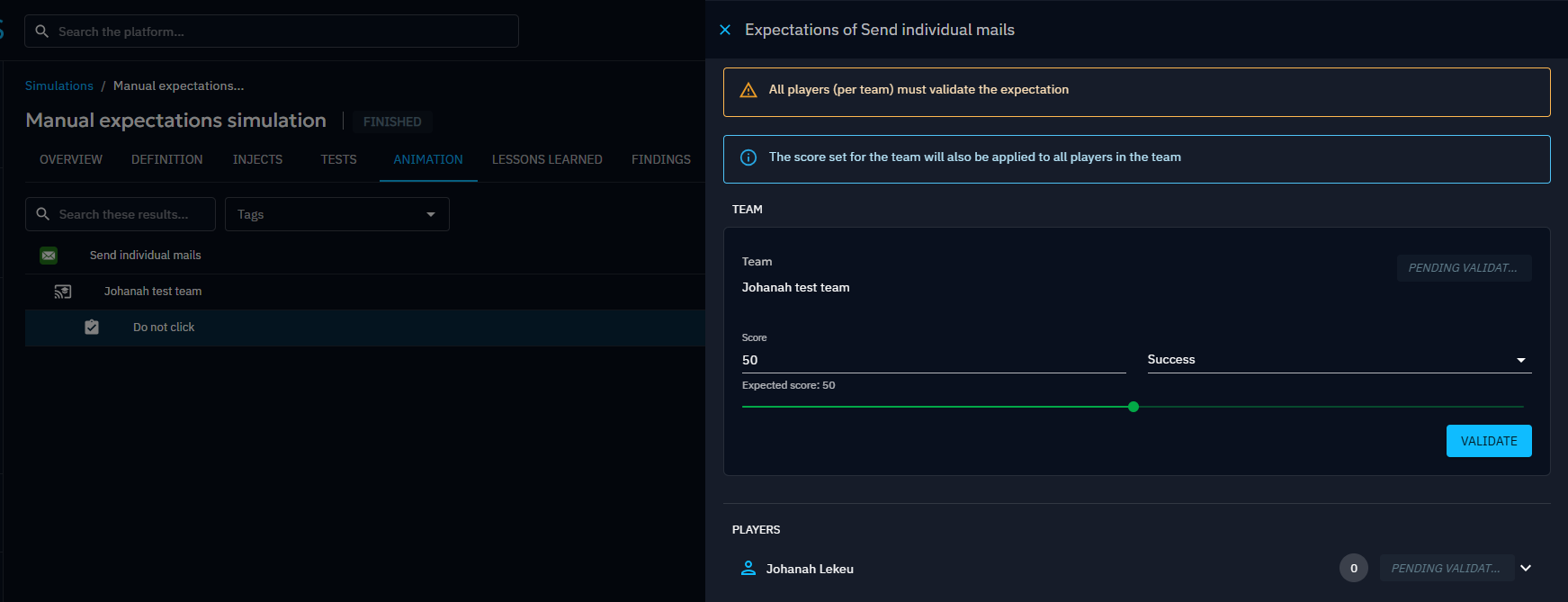
Example
You simulate a phishing campaign.
Expectation:
The Incident Response team acknowledges and escalates the phishing email.
- The SOC receives the inject
- The analyst follows the playbook and opens a ticket
- The organizer validates the expectation
✅ Result: Success (100)
Automatic Expectations (Detailed)
An Automatic Expectation is validated when a technical condition is met.
Validation relies on:
- connected security integrations
- or manually provided technical results
Why use it?
Automatic expectations allow you to:
- Measure real security controls
- Avoid subjective validation
- Scale exercises across many Assets and Agents
They are essential for technical simulations and Breach & Attack Simulation use cases.
Available automatic expectation types
| Type | What it validates |
|---|---|
| Prevention | A control blocks the attack |
| Detection | A security alert or incident is raised |
| Vulnerability | A CVE is present on the target |
| Article | Targets read or acknowledge the article |
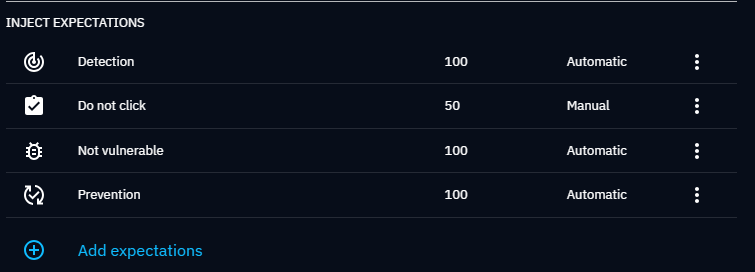
Example
You launch a malware simulation.
Expectation:
Endpoint protection detects the payload.
- The EDR raises an alert
- OpenAEV receives the detection event
✅ Result: Success (100)
Validation Modes (Detailed)
A Validation Mode defines how individual target results are aggregated at group level.
Each expectation uses exactly one validation mode.
All targets must validate
When should I use it?
Use this mode when every member must succeed, such as:
- mandatory training
- compliance requirements
- baseline security checks
How does it work?
- All targets succeed → 100
- At least one target fails → 0
Example
Group of 4 players:
- 3 succeed, 1 fails → 0 (Failed)
- 4 succeed → 100 (Success)
At least one target must validate
When should I use it?
Use this mode when a single successful response is enough, such as:
- SOC detection
- on-call escalation
- redundancy testing
How does it work?
- ≥ 1 success → 100
- No success → 0
Example
Group of 4 players:
- 1 succeeds, 3 fail → 100 (Success)
- 4 fail → 0 (Failed)
Result Aggregation per Expectation
What is this?
A single Expectation can receive multiple validation results for the same Inject.
This happens when:
- several security tools monitor the same Asset
- multiple collectors report results
- results are added both manually and automatically
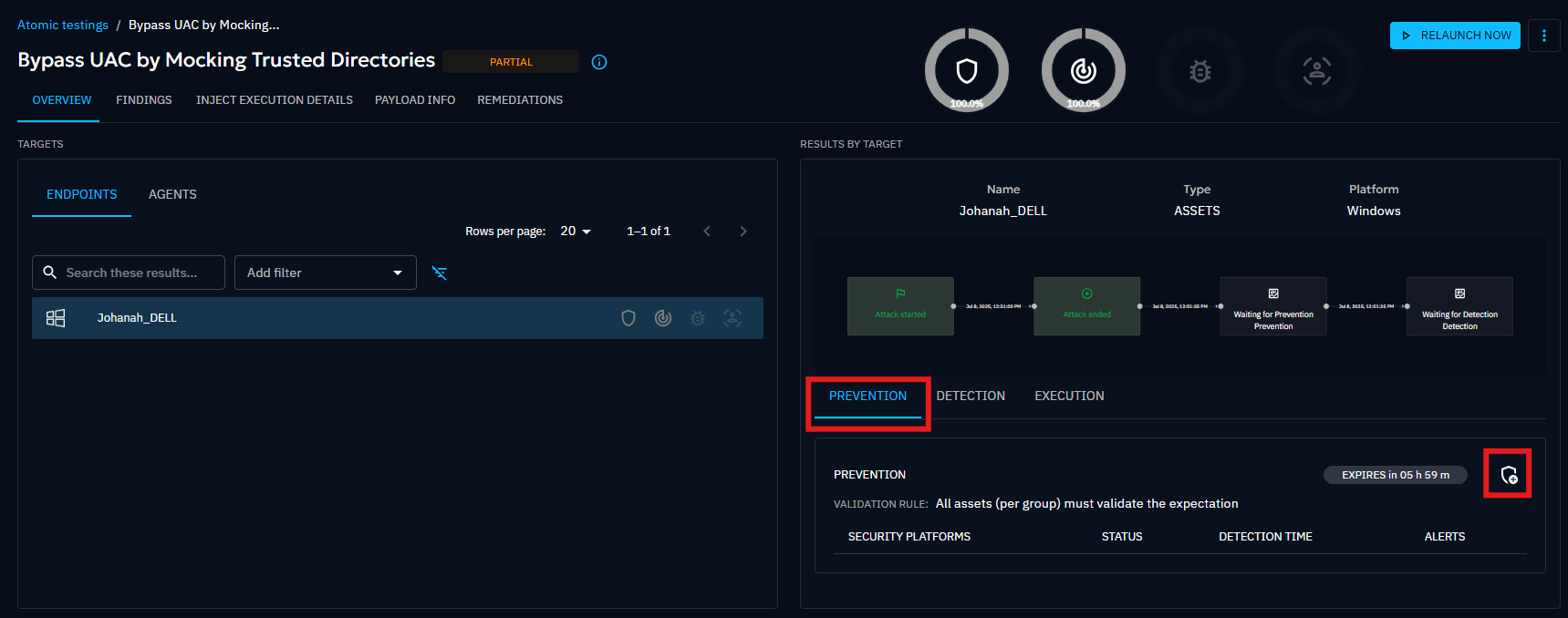
Why does OpenAEV work this way?
OpenAEV evaluates effective protection, not individual tool accuracy.
If at least one control detects or prevents the attack, the organization did not fully fail.
This avoids:
- false negatives caused by tool overlap
- penalizing layered defense strategies
How is the final result computed?
- All results are collected
- Results are ordered by severity
- The highest result always wins
⚠️ A negative result never overrides a positive one.
Example
| Tool | Result |
|---|---|
| Microsoft Defender | Detected |
| CrowdStrike | Not Detected |
Final expectation result:
✅ Detected
Status Propagation
Expectation results propagate from technical entities to organizational entities.
| Entity | Rule |
|---|---|
| Agent | Direct result (0 or 100) |
| Asset | Valid only if all Agents succeed |
| Asset Group | Depends on validation mode |
| Player | Depends on validation mode |
| Team | Aggregated from Players |
⚠️ Validation mode always applies at group level.