Collector development
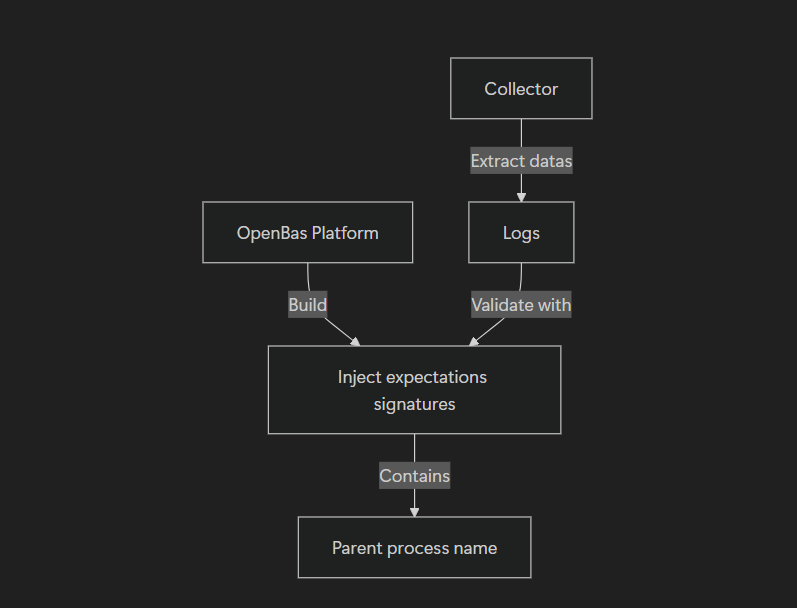
This page explains what OpenAEV expects from a Collector: a process that reads the security events of a detection or prevention product, such as an EDR (Endpoint Detection and Response) or a SIEM (Security Information and Event Management), and matches them against the expectations of the Injects that OpenAEV executed.
To set up a new Collector project (template, pyoaev dependency, local development), follow the Collectors repository README. For a functional overview, see Collectors.
How a Collector works with OpenAEV
- Register. The Collector registers through
POST /api/collectorsand appears under Integrations > Deployed. - Read the expectations. At each run, it fetches the expectations it has not answered yet. Answer them quickly to measure how fast the product responds.
- Match and report. It compares each expectation's signatures with the product's alerts, then tells OpenAEV whether the attack was prevented or detected (see Report a result).
You do not need to fail late expectations yourself: the expectation expiration job of OpenAEV marks unanswered expectations as expired after a timeout (see Platform managers).
Report a result
The Collector reports its result through PUT /api/injects/expectations/{expectation_id}, or through PUT /api/injects/expectations/bulk to answer several expectations in one call. The body carries the following fields:
| Field | Required | Description |
|---|---|---|
collector_id |
Yes | ID of the Collector that answers. |
is_success |
Yes | true if the product prevented or detected the attack, false otherwise. |
metadata |
No | Key-value pairs kept on the result, such as the ID or the link of the matching alert. If the Collector answers the same expectation again without metadata, OpenAEV keeps the previous ones. |
result |
No | Deprecated and ignored. |
OpenAEV derives the result label from is_success and the expectation type: Prevented or Not Prevented for a prevention expectation, Detected or Not Detected for a detection expectation.
When the Collector answers an Asset or an asset group expectation, OpenAEV applies the result to each agent expectation below it (or to the Asset itself when it has no agent), then recomputes the Asset and the asset group from their agents (see Expectations).
Bulk call
Signatures
A signature is a way to find an attack in an alert. The main ones are:
| Signature | Description |
|---|---|
parent_process_name |
Name of the parent process of the attack. For the OpenAEV implant, it is oaev-implant-<inject_id>-agent-<agent_id> (the file itself has .exe on Windows). |
source_ipv4_address, source_ipv6_address |
IP address of the Asset that ran the attack. |
target_ipv4_address, target_ipv6_address, target_hostname_address |
IP address or hostname targeted by the attack. |
For reference implementations, see the CrowdStrike, Microsoft Defender and Microsoft Sentinel Collectors.
What's next?
- Deploy Collectors -- Deploy and configure a Collector
- Expectations -- Understand the expectations a Collector answers
- Injector development -- Build a custom Injector